
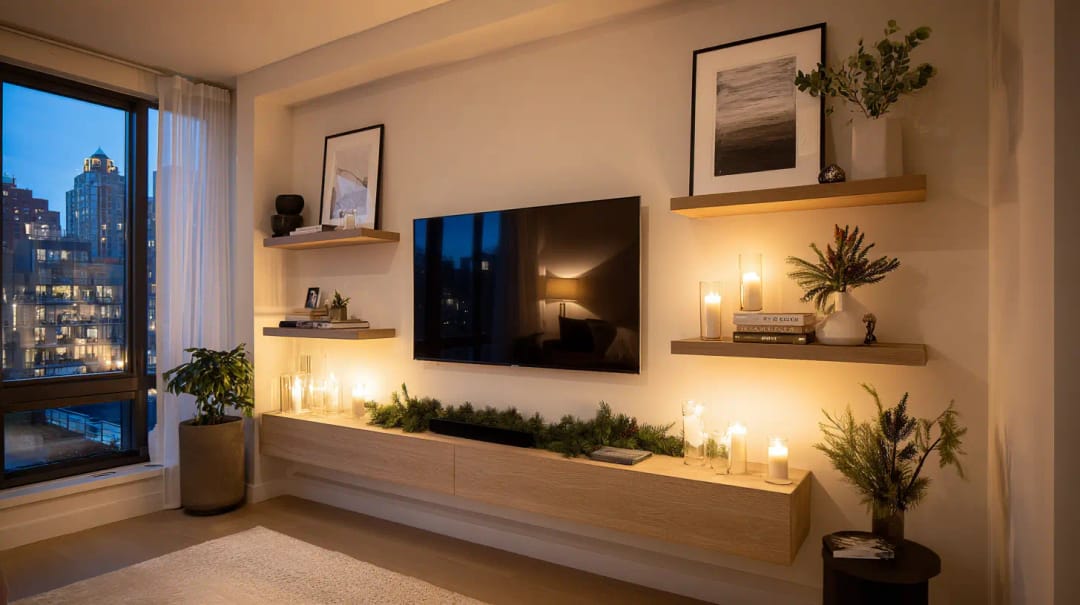
New York apartments make TV mounting more interesting than the box suggests: narrow living rooms, big windows, prewar plaster, brick party walls and poured-concrete towers. Choosing the mount comes first — then the anchoring plan for your wall.
Three types of mount
Fixed
Best for: seating straight in front of the screen, at a comfortable height. A fixed mount holds the TV closest to the wall for the cleanest look and has no moving parts. It can’t tilt away glare or turn toward another seat, so it works best when the TV is at eye level and away from a bright window.
Tilting
Best for: a TV mounted a little higher — above a console or a low fireplace — or a room with glare from above. A few degrees of downward tilt keeps the picture comfortable and cuts reflections. Leave enough slack in the cables for the movement.
Full-motion (articulating)
Best for: open-plan studios, corners and rooms where you watch from more than one spot. The arm pulls the TV out and swivels it. Because it puts more leverage on the wall, the arm has to be rated for your TV’s weight and size and anchored into solid structure — studs, masonry or concrete, not hollow drywall alone.
Whichever you choose, check the mount’s rating for your TV’s weight and screen size, and that it fits the VESA hole pattern on the back of the TV.
What’s behind the wall matters as much as the mount
| Wall | What it means for mounting |
|---|---|
| Drywall on wood studs | The mount goes into the studs. If studs don’t line up with where you want the TV, a mount with a wider plate or a different position solves it — not a handful of drywall anchors. |
| Drywall on metal studs | Common in newer buildings. Metal studs need hardware made for them; screws meant for wood won’t hold. |
| Prewar plaster | Hard, brittle and often over wood lath or masonry. It needs slow, careful drilling to avoid cracks, and anchoring into what’s behind the plaster. |
| Brick | Anchors go into solid brick, not the softer mortar joints, with masonry anchors sized for the load. |
| Poured concrete | Strong, but buildings often have rules about drilling — especially post-tensioned slabs. Concrete-rated anchors, masonry bits, and the building’s approval where required. |
If you’re not sure what your wall is, tell your installer the building’s age and type — prewar, postwar or new construction — and send a photo.
Plan the cables before you choose the height
- Cord cover: a paintable raceway on the wall surface. Simple, renter-friendly and works on any wall.
- Inside the wall: the cleanest look, but electrical codes don’t allow a TV’s ordinary power cord to run inside the wall. In-wall concealment uses a rated in-wall power kit or a proper outlet behind the TV.
- Masonry and concrete walls usually can’t hide cables inside, so a cord cover or furniture placement is the practical answer.
More on the options in our TV wire concealment guide.
Before the installer arrives
- Decide the height with painter’s tape on the wall — see how high to mount a TV.
- Have the mount on site, rated for your TV.
- Clear the wall and the furniture in front of it.
- Check your building’s rules and request a certificate of insurance if your co-op or condo needs one.
If you’d rather not deal with any of it, ArtFixPro mounts TVs across Manhattan and NYC on drywall, plaster, brick and concrete.